Fast, Efficient and Scalable Solutions

DaniGuruji .Com

NCERT Mathematics Ganita Prakash Solutions for class 8 Chapter 2 POWER PLAY

Explore the comprehensive NCERT Textbook Solutions for Class VIII.

KEY Concept For Chpt. 2 Power Play

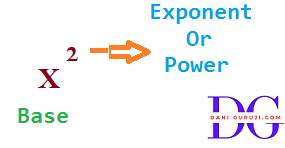
Exponents means power


Key Formulas

If we have 'a' and 'b' as the base and 'm' and 'n' as the exponents, then.


Multiplication of same base

$ {a^m × a^n } = a^{m + n}$

Example : $ {2^3 × 2^4 }= 2^{3 + 4} = 2^7 $


Division of same base

$ {a^m \over { a^n} } = a^{m - n}$

Example : $ {3^5 \over { 3^2} }= 3^{5 - 2} = 3^3 $


Power of a power

$ {(a^m )^n } = a^{m × n}$

Example : $ {(2^4 )^2 } =( 2^{4 × 2}) = 2^8 $


Negative exponent

$ {a^{-m} } = { 1 \over {a^m}} $

Example : $ {5^{-3} } = { 1 \over {5^3}}$


Zero exponent (a ≠ 0)

$ {a^0 } = 1 $

Example : $ {7^0 } = 1 $


Scientific notation

$ a × 10^n $


Multiplication of different base but same power

$ {a^m × b^m } = {(ab)^m} $

Example : $ {3^2 × 5^2 } = {(3×5)^2} = 15^2 $


Power Play ⇒⇒ Exercise 2

Page 20
Question 1

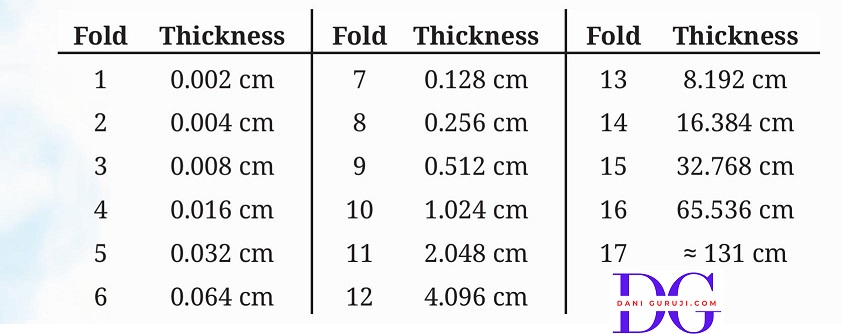
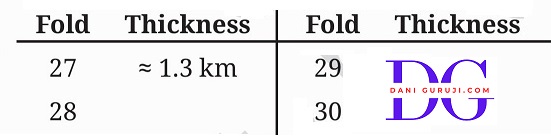
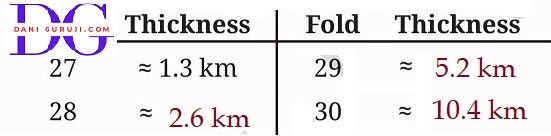
The following table lists the thickness after each fold. Observe that the thickness doubles after each fold.


(We use the sign ‘≈’ to indicate ‘approximately equal to’.)

After 10 folds, the thickness is just above 1 cm (1.024 cm). After 17 folds, the thickness is about 131 cm (a little more than 4 feet).


Now, what do you think the thickness would be after 30 folds? 45 folds? Make a guess.


Solution :


This is a demonstrates the power of exponential growth! The thickness is doubling with every fold.

Fold 1: $0.002 \text{ cm}$

Fold 2: $0.004 \text{ cm} = 0.002 \times 2$

Fold 3: $0.008 \text{ cm} = 0.002 \times 2^2$


The formula for the thickness $T$ after $n$ folds,

$$T_n = T_1 \times 2^{n-1} = 0.002 \times 2^{n-1} \text{ cm}$$


For $n=30$:

$$T_{30} = 0.002 \times 2^{30-1} = 0.002 \times 2^{29} \text{ cm}$$

$$T_{30} = 0.002 \times 536,870,912 \text{ cm} $$

$$T_{30} = \mathbf{1,073,741.824 \text{ cm}}$$

$$T_{30} = 10.74 \text{ km}$$


For $n=45$:

$$T_{45} = 0.002 \times 2^{45-1} = 0.002 \times 2^{44} \text{ cm}$$

$$T_{45} = 0.002 \times 17,592,186,044,416 \text{ cm}$$

$$T_{45} = \mathbf{35,184,372,088.832 \text{ cm}}$$

$$T_{45} = 351,844 \text{ km}$$


Question 2

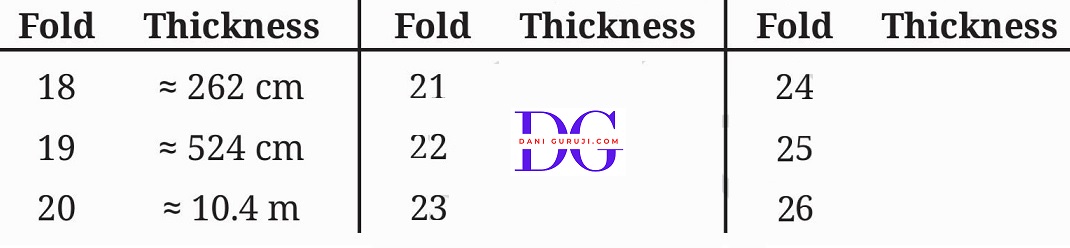
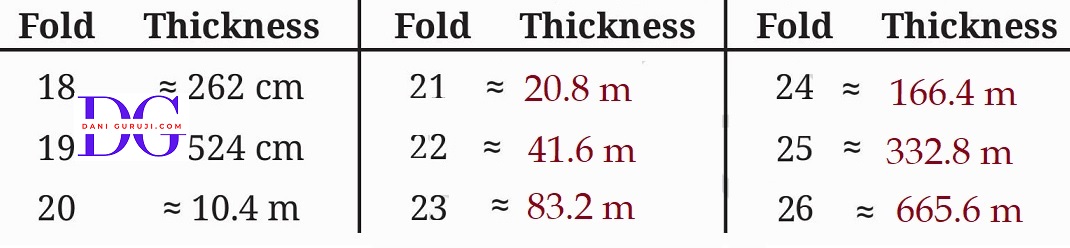
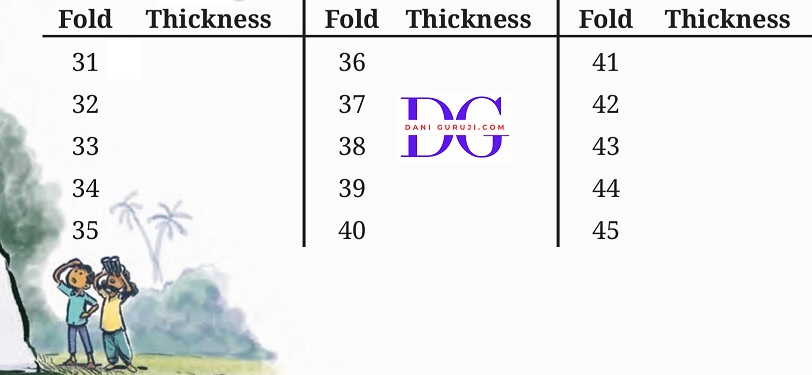
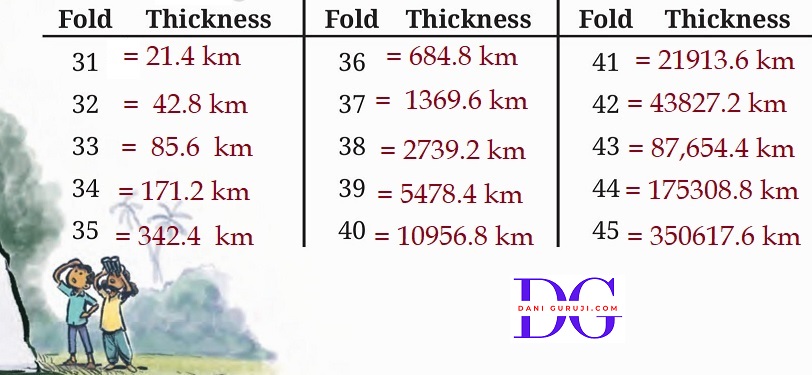
Fill the table below.


Solution :


Question 3

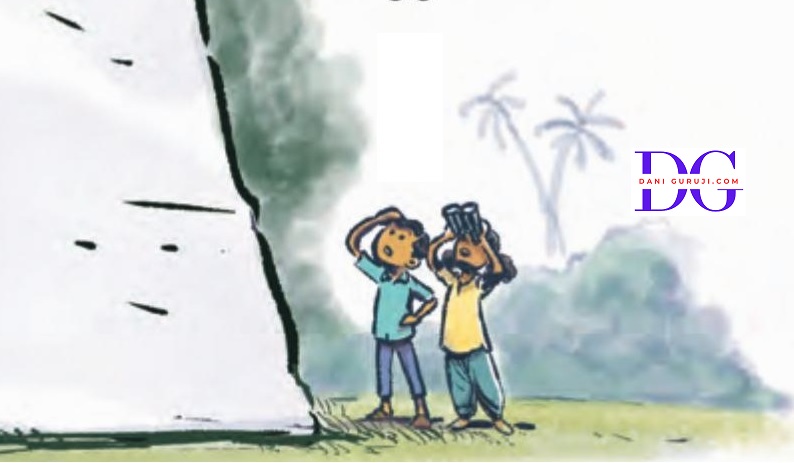
After 26 folds, the thickness is approximately 670 m. Burj Khalifa in Dubai, the tallest building in the world, is 830 m tall.


Solution :


Question 4

After 30 folds, the thickness of the paper is about 10.7 km, the typical height at which planes fly. The deepest point discovered in the oceans is the Mariana Trench, with a depth of 11 km.


Solution :


Page 22
Question 1

Which expression describes the thickness of a sheet of paper after it is folded 10 times? The initial thickness is represented by the letter-number v.
(i) 10v
(ii) 10 + v
(iii) $2 \times 10 \times v$
(iv) $2^{10}$
(v) $2^{10}v$
(vi) $10^2v$


Solution :


Initial Thickness: $v$

After 1 fold: The thickness doubles, becoming $v \times 2 = 2v$.


Following this pattern, the thickness $T$ after $n$ folds is given by the formula:

$$T = v \times 2^n$$


For 10 folds ($n=10$), the expression is:

Therefore, the thickness of a sheet of paper after 10 folds = $$T = v \times 2^{10} = \mathbf{2^{10}v}$$


The correct expression is (v) $2^{10}v$.


Question 2

What is $(-1)^5$? Is it positive or negative? What about $(-1)^{56}$ ?


Solution :


The Rule of Exponents for Negative Bases

The sign of $(-1)$ raised to a power depends entirely on whether the exponent is odd or even.


Odd Exponent: A negative base raised to an odd power will always be negative.


Even Exponent: A negative base raised to an even power will always be positive.


1. $(-1)^5$


The exponent is 5, which is an odd number.

Value: $(-1)^5 = -1 \times -1 \times -1 \times -1 \times -1 = \mathbf{-1}$

Sign: $\mathbf{Negative}$


2. $(-1)^{56}$


The exponent is 56, which is an even number.

Value: $(-1)^{56} = \mathbf{1}$

Sign: $\mathbf{Positive}$


Question 3

Is $(-2)^4$= 16 ? Verify.


Solution :


The exponent of $4$ means you multiply the base, $(-2)$, by itself four times:


$$(-2) \times (-2) \times (-2) \times (-2) $$

$$4 \times 4 = \mathbf{16}$$


Therefore, $(-2)^4 = 16$ is correct.


Question 4

What is $(0)^2$, $(0)^5$ ? What is $(0)^n$.


Solution :


$0^2$ means $0$ multiplied by itself $2$ times:

$$0^2 = 0 \times 0 = \mathbf{0}$$


$0^5$ means $0$ multiplied by itself $5$ times:

$$0^5 = 0 \times 0 \times 0 \times 0 \times 0 = \mathbf{0}$$


In general, for any positive integer $n$, $0^n$ is always 0. $$0^n = \mathbf{0}$$

The rule is: Zero raised to any positive power is zero.


Page 22 Figure it Out
Question 1

Express the following in exponential form:
(i) 6 × 6 × 6 × 6
(ii) y × y
(iii)b × b × b × b
(iv) 5 × 5 × 7 × 7 × 7
(v) 2 × 2 × a × a
(vi) a × a × a × c × c × c × c × d


Solution :


To express a repeated multiplication in exponential form, you use the number or variable being multiplied as the base and the count of how many times it's multiplied as the exponent (or power).


(i) $\mathbf{6^4}$

(ii) $\mathbf{y^2}$

(iii) $\mathbf{b^4}$


(iv) $\mathbf{5^2 \times 7^3}$

(v) $\mathbf{2^2 \times a^2}$

(vi)$\mathbf{a^3 c^4 d}$


Question 2

Express each of the following as a product of powers of their prime factors in exponential form.
(i) 648 (ii) 405
(iii) 540 (iv) 3600


Solution :


Prime Factorization in Exponential Form


(i) Prime factors of 648 = 2 × 2 × 2 × 3 × 3 × 3 × 3

Exponential Form :$$\mathbf{648 = 2^3 \times 3^4}$$


(ii) Prime factors of 405 = 3 × 3 × 3 × 3 × 5

Exponential Form :$$\mathbf{405 = 3^4 \times 5}$$


(iii) Prime factors of 540 = 2 × 2 × 3 × 3 × 3 × 5

Exponential Form :$$\mathbf{540 = 2^2 \times 3^3 \times 5}$$


(iv) Prime factors of 3600 = 2 × 2 × 2 × 2 × 3 × 3 × 5 × 5

Exponential Form :$$\mathbf{3600 = 2^4 \times 3^2 \times 5^2}$$


Question 3

Write the numerical value of each of the following:
(i) $2 \times 10^3$
(ii) $7^2 \times 2^3$
(iii) $3 \times 4^4$
(iv) $(-3)^2 \times (-5)^2$
(v) $3^2 \times 10^4$
(vi) $(-2)^5 \times (-10)^6$


Solution :


Numerical Values of Expressions


(i) $2 \times 10^3$

→ $2 \times 1,000$

= 2,000


(ii) $7^2 \times 2^3$

→ $49 \times 8$

= 392


(iii) $3 \times 4^4$

→ $3 \times 256$

= 768


(iv) $(-3)^2 \times (-5)^2$

→ $9 \times 25$

= 225


(v) $3^2 \times 10^4$

→ $9 \times 10,000$

= 90,000


(vi) $(-2)^5 \times (-10)^6$

→ $(-32) \times (1,000,000)$

= -32,000,000


Page 24
Question 1

$3^7$ can also be written as $3^2$ × $3^5$. Can you reason out why?


Solution :


The Product of Powers Rule


The rule states that when you multiply two powers that have the same base, you can add their exponents.

$$\mathbf{a^m \times a^n = a^{m+n}}$$


Therefore, $$\begin{align*} 3^2 \times 3^5 &= 3^{(2 + 5)} \\ &= \mathbf{3^7}\end{align*}$$


Question 2

$ na × nb = n^{(a+b)}$, where a and b are counting numbers.
Use this observation to compute the following.
(i) $2^9$
(ii) $5^7$
(iii) $4^6$


Solution :


(i) $2^9$


$$2^9 = 2 \times 2 \times 2 \times 2 \times 2 \times 2 \times 2 \times 2 \times 2 $$

$$2^9 = 2^3 \times 2^3 \times 2^3 $$

$$2^9 = 8 \times 8 \times 8 $$

$$ = 512 $$


(ii) $5^7$


$$5^7 = 5 \times 5 \times 5 \times 5 \times 5 \times 5 \times 5 $$

$$5^7 = 5^2 \times 5^2 \times 5^2 \times 5$$

$$5^7 = 25 \times 25 \times 25 \times 5 $$

$$ = \mathbf{78,125} $$


(iii) $4^6$


$$4^6 = 4 \times 4 \times 4 \times 4 \times 4 \times 4 $$

$$4^6 = 4^2 \times 4^2 \times 4^2 $$

$$4^6 = 16 \times 16 \times 16 $$

$$ = \mathbf{4,096}$$


Question 3

Write the following expressions as a power of a power in at least two different ways:
(i) $8^6$
(ii) $7^{15}$
(iii) $9^{14}$
(iv) $5^8$


Solution :


The Powers of power Rule

$$(\mathbf{x^a})^b = \mathbf{x^{(a \times b)}}$$


we need to find two factors, $a$ and $b$, whose product is the original exponent. Since $a \times b = \text{Original Exponent}$, we can write the expression as $(\text{Base}^a)^b$.


(i) $8^6$


Way 1: Using $2 \times 3$

$$\mathbf{8^6} = (8^2)^3$$

Way 2: Using $3 \times 2$

$$\mathbf{8^6} = (8^3)^2$$


(ii) $7^{15}$


Way 1: Using $3 \times 5$

$$\mathbf{7^{15}} = (7^3)^5$$

Way 2: Using $5 \times 3$

$$\mathbf{7^{15}} = (7^5)^3$$


(iii) $9^{14}$


Way 1: Using $2 \times 7$

$$\mathbf{9^{14}} = (9^2)^7$$

Way 2: Using $7 \times 2$

$$\mathbf{9^{14}} = (9^7)^2$$


(iv) $5^8$


Way 1: Using $2 \times 4$

$$\mathbf{5^8} = (5^2)^4$$

Way 2: Using $4 \times 2$

$$\mathbf{5^8} = (5^4)^2$$


Page 25
Question 1

In the middle of a beautiful, magical pond lies a bright pink lotus.
The number of lotuses doubles every day in this pond. After 30 days, the pond is completely covered with lotuses.
On which day was the pond half full?
If the pond is completely covered by lotuses on the 30th day,
how much of it is covered by lotuses on the 29th day?


Solution :


Since the number of lotuses doubles every day, to go from half coverage to full coverage takes exactly one day.


If the pond is fully covered on Day 30, it must have been half covered on the day before, which is Day 29.


The pond was exactly half full on the 29th day.


Question 2

Write the number of lotuses (in exponential form) when the pond was —.
(i) fully covered
(ii) half covered


Solution :


The number of lotuses is doubling daily. If we let $1$ be the number of lotuses on the first day,


Since the number of lotuses doubles every day. So,


On day 1: 1 lotus = $2^0$

On day 2: 1 × 2 = 2 lotuses = $2^1$

On day 3: 2 × 2 = 4 lotuses = $2^2$

On day 4: 4× 2 = 8 lotuses = $2^3$


The number of lotuses on any day, $n$, is given by $ 2^{(n-1)}$.


(i) The number of lotuses when the pond was Fully covered (Day 30) = $ 2^{(30-1)}$ = $ 2^{(29)}$


(ii) The number of lotuses when the pond was Half covered (Day 29) = $ 2^{(29-1)}$$ = 2^{(28)}$


Question 3

$\mathbf{m^a \times n^a = (mn)^a}$, where a is a counting number.
Use this observation to compute the value of $2^5 \times 5^5$.


Solution :


The Powers of power Rule

$\mathbf{m^a \times n^a = (mn)^a}$


Given the expression $2^5 \times 5^5$:

Since the exponent ($a=5$) is the same for both bases ($m=2$ and $n=5$), we multiply the bases and keep the exponent.


$$2^5 \times 5^5 $$

$$= (2 \times 5)^5$$

$$ = (10)^5$$

$$(10)^5 = 10 \times 10 \times 10 \times 10 \times 10 $$

$$(10)^5 = \mathbf{100,000}$$


Question 4

Simplify $\mathbf{10^4 / 5^4}$ and write it in exponential form.


Solution :


The expression $\mathbf{10^4 / 5^4}$ can be simplified using the Quotient of Powers Rule,

which states that when dividing powers with the same exponent, you can divide the bases and keep the exponent the same:

$$\frac{m^a}{n^a} = \left(\frac{m}{n}\right)^a$$

$$\frac{10^4}{5^4} = \left(\frac{10}{5}\right)^4$$

$$\left(\frac{2 \times 5}{5}\right)^4 = \mathbf{2^4}$$


The simplified expression in exponential form is $\mathbf{2^4}$.


Page 26 How Many Combinations
Question 1

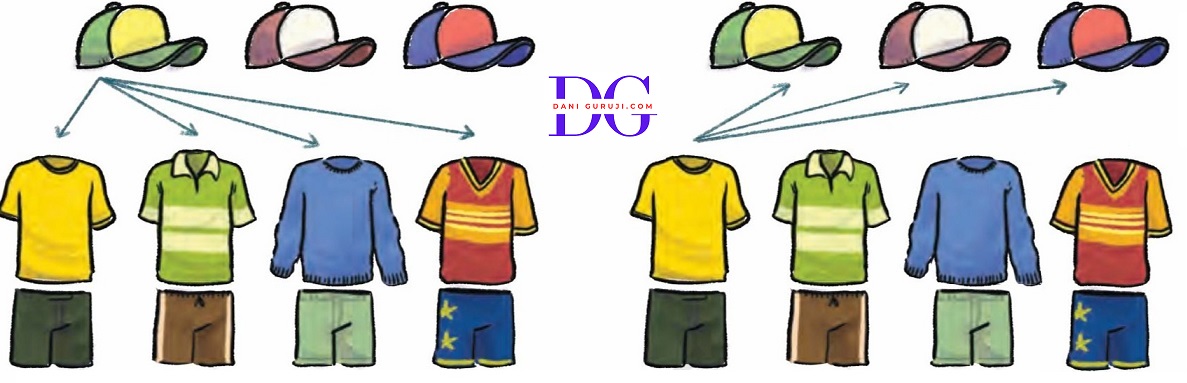
Roxie has 7 dresses, 2 hats, and 3 pairs of shoes. How many different ways can Roxie dress up?


Solution :


Roxie's choices are independent:

Dresses: 7 options

Hats: 2 options

Shoes: 3 options


The total number of different ways Roxie can dress up is the product of the number of choices for each item:


$\text{Total Ways} = (\text{Dresses}) \times (\text{Hats}) \times (\text{Shoes})$

$\text{Total Ways} = 7 \times 2 \times 3$

$\text{Total Ways} = 42 $


Roxie can dress up in 42 different ways.


Question 2

Estu and Roxie came across a safe containing old stamps and coins that their great-grandfather had collected. It was secured with a 5-digit password. Since nobody knew the password, they had no option except to try every password until it opened. They were unlucky and the lock only opened with the last password, after they had tried all possible combinations. How many passwords did they end up checking?


Solution :


This is calculated by considering that a 5-digit password has 5 positions, and each position can be any of the 10 digits (0 through 9).

Since the digits can be repeated, the total number of combinations is:


$$10 \times 10 \times 10 \times 10 \times 10 $$

$$ = 10^5 $$

$$ = 100,000$$


So Estu and Roxie ended up checking: 100,000 passwords with the safe finally unlocking on that very last one.


Question 3

Estu says, “Next time, I will buy a lock that has 6 slots with the letters A to Z. I feel it is safer.” How many passwords are possible with such a lock?


Solution :


The total number of possible passwords with a 6-slot lock, where each slot can be any of the 26 letters (A to Z).

This is calculated by multiplying the number of options for each of the 6 independent slots:


$$26 \times 26 \times 26 \times 26 \times 26 \times 26 $$

$$ = 26^6 $$

$$ = 308,915,776$$


So, The total number of possible passwords with a 6-slot lock is 308,915,776.


Question 4

Think about how many combinations are possible in different contexts. Some examples are — (i) Pincodes of places in India — The Pincode of Vidisha in Madhya Pradesh is 464001. The Pincode of Zemabawk in Mizoram is 796017. (ii) Mobile numbers. (iii) Vehicle registration numbers. Try to find out how these numbers or codes are allotted/generated.


Solution :


1. Pincodes (Postal Index Number)


The 6-digit Pincode is not random; it's a geographically structured code used to simplify the sorting and delivery of mail.


First Digit (Zone): Represents one of the nine postal zones in the country (e.g., '1' for North, '4' for Central India, '7' for East, '9' for the Army Postal Service).

First Two Digits (Sub-Zone/Circle): Indicate the postal circle (state or Union Territory). For example, '46' is for Madhya Pradesh.

First Three Digits (Sorting District): Identify the sorting district headquartered at the main post office of the largest city in the region. For example, '464' is the sorting district that includes Vidisha.

Last Three Digits (Delivery Post Office): Represent the specific delivery post office within the sorting district.


Since it's a 6-digit number, where each digit can be 0-9, the total possible combinations are $10^6$.

Combinations =

$ 10 \times 10 \times 10 \times 10 \times 10 \times 10 $

$\text{Combinations} = \mathbf{1,000,000}$


The number of actually allotted codes is much smaller, as the first digit is restricted (0 is not used, 9 is for the Army), and the codes are only created as post offices are established.


2. Mobile Number Allotment System


Indian mobile numbers are 10 digits long and are highly structured:

Theoretical Maximum (10 digits): If any digit (0-9) could be used, the total combinations would be $10^{10}$.

$$\text{Combinations} = 10^{10} $$

$$ \mathbf{10,000,000,000} \text{ (10 Billion)}$$


Actual Used Codes (Start with 6, 7, 8, or 9): Since the first digit is restricted to 4 choices (6, 7, 8, 9), the maximum pool is reduced:

Combinations = $ 4 \times 10 \times 10 \times 10 \times 10 \times 10 $ $\times 10 \times 10 \times 10 \times 10 $

$= 4 \times 10^9 $

$ = \mathbf{4,000,000,000} \text{ (4 Billion)}$


3. Vehicle Registration Allotment System


(Standard Format: $\text{XX YY Z ZZZZ}$)


Part 1: State/UT Code (XX)


Part 2: District RTO Code (YY).


Part 3: Running Series Code (Z/ZZ)


Last 4 Digits: Unique Number (ZZZZ): A four-digit number from 0001 to 9999.


Combinations for Vehicle Registration Allotment System


The total capacity of a single RTO is calculated by the number of possible series multiplied by the number of unique numbers in a series.


A single series (e.g., MH 12 A 0001 to MH 12 A 9999) can accommodate 9,999 vehicles.


The single-letter series allows for 24 letters (A-H, J-N, P-Z, excluding I and O).


Single-letter series combinations =

$$ 24 \times 9,999 $$

$$ \approx \mathbf{240,000}$$


The two-letter series (AA, AB... ZZ) is much larger. With 24 usable letters in each of the two positions, there are $24 \times 24 = 576$ possible two-letter series.


Two-letter series combinations =

$$ 576 \times 9,999 $$

$$ \approx \mathbf{5,759,000}$$


The total capacity for a single RTO is thus several million registration numbers,

Question 5

What is $2^{100}$ ÷ $2^{25} $in powers of 2?


Solution :


When dividing exponents with the same base, you subtract the powers:

$$\frac{a^m}{a^n} = a^{m-n}$$


In the given case, the base ($a$) is $2$, the exponent in the numerator ($m$) is $100$, and the exponent in the denominator ($n$) is $25$:

$$ 2^{100} \div 2^{25} $$

$$ = 2^{(100 - 25)} $$

$$ = \mathbf{2^{75}}$$


Page 29
Question 1

Consider the following general forms we have identified.
We had required a and b to be counting numbers. Can a and b be any integers? Will the generalised forms still hold true?


Solution :


Yes, the generalized forms above identified still hold true when the exponents $a$ and $b$ are any integers (positive, negative, or zero), provided the base $n$ is a non-zero number.


General Forms of Exponent Rules


1. Product Rule: $n^a \times n^b = n^{a + b}$

Holds True: Yes.

Example (Using negative integers): Let $n=5$, $a=3$, and $b=-2$

$$ 5^3 \times 5^{-2} $$

$$ = 5^{3 + (-2)} $$

$$ = 5^1 = 5$$


2. Power Rule: $(n^a)^b = (n^b)^a = n^{a \times b}$

Holds True: Yes.

Example (Using negative integers): Let $n=2$, $a=-3$, and $b=4$

$$ (2^{-3})^4 $$

$$ = 2^{(-3) \times 4} $$

$$ = 2^{-12}$$


3. Quotient Rule: $n^a \div n^b = n^{a - b}$

Holds True: Yes.

Example (Using negative integers): Let $n=10$, $a=2$, and $b=-3$

$$ 10^2 \div 10^{-3} $$

$$ = 10^{2 - (-3)} $$

$$ = 10^{2 + 3} $$

$$ = 10^5 = 100,000$$


Question 2

Write equivalent forms of the following.
(i) $2^{-4}$
(ii) $10^{-5}$
(iii) $(-7)^{-2}$
(iv) $(-5)^{-3}$
(v) $10^{-100}$


Solution :


(i) $2^{-4}$

$$= \frac{1}{2^4} = \frac{1}{16}$$


(ii) $10^{-5}$

$$= \frac{1}{10^5} = \frac{1}{100,000}$$


(iii) $(-7)^{-2}$

$$= \frac{1}{-7^2} = \frac{1}{49}$$


(iv) $(-5)^{-3}$

$$ = \frac{1}{(-5)^3} = -\frac{1}{125}$$


(v) $10^{-100}$

$$ = \frac{1}{10^{100}} $$


Question 3

Simplify and write the answers in exponential form.
(i) $2^{-4} \times 2^7$
(ii) $3^2 \times 3^{-5} \times 3^6$
(iii) $p^3 \times p^{-10}$
(iv) $2^4 \times (-4)^{-2}$
((v) $8^p \times 8^q$


Solution :


(i) $2^{-4} \times 2^7$

Using the Product Rule, add the exponents:

$$2^{-4} \times 2^7 $$

$$= 2^{(-4 + 7)} = \mathbf{2^3}$$


(ii) $3^2 \times 3^{-5} \times 3^6$

Add all the exponents:

$$ = 3^{(2 + (-5) + 6)} $$

$$ = 3^{(2 - 5 + 6)} $$

$$ = 3^{(3)} = \mathbf{3^3}$$


(iii) $p^3 \times p^{-10}$

Add all the exponents:

$$p^3 \times p^{-10} $$

$$= p^{(3 + (-10))} $$

$$ = p^{(3 - 10)} = \mathbf{p^{-7}}$$


(iv) $2^4 \times (-4)^{-2}$

First, rewrite the base $(-4)$ as a power of 2

$$(-4)^{-2} = \frac{1}{(-4)^2} $$

$$= \frac{1}{4^2} = \frac{1}{(2^2)^2}$$

$$ = \frac{1}{2^4} = 2^{-4}$$


Substitute this back into the original expression

$$2^4 \times (-4)^{-2} $$

$$= 2^4 \times 2^{-4} $$

$$ = 2^{(4 + (-4))} $$

$$ = 2^0 = \mathbf{1}$$


(v) $8^p \times 8^q$

Using the Product Rule, add the exponents:

$$8^p \times 8^q $$

$$ = \mathbf{8^{(p+q)}}$$

since $8 = 2^3$,

$$= (2^3)^{(p+q)} $$

$$ = 2^{3(p+q)} $$

$$ = 2^{3p+3q}$$


Page 30 Power Lines
Question 1

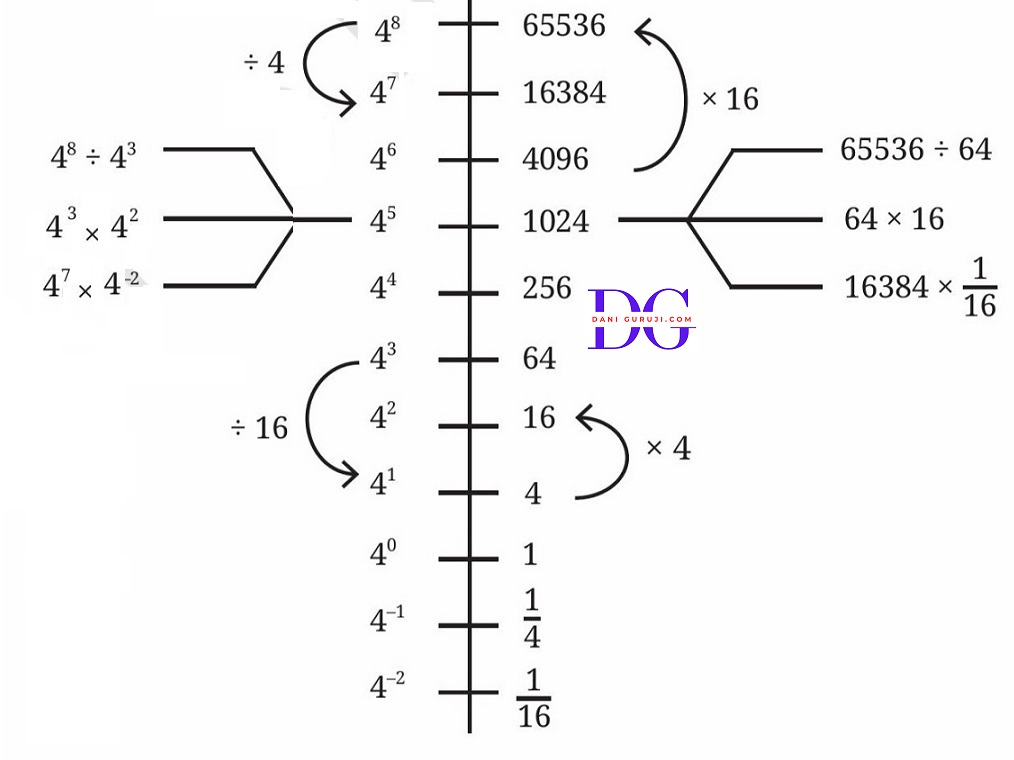
How many times larger than $4^{-2}$ is $4^{2}$ ?


Solution :


Calculate the value of $4^2$

$$4^2 = 16$$


Calculate the value of $4^{-2}$:

$$4^{-2} = \frac{1}{4^2}$$

$$ = \frac{1}{16}$$


Divide the larger value by the smaller value

$$\frac{16}{\frac{1}{16}}$$

$$ = 16 \times 16 $$

$$ = 256$$


The value $4^2$ is 256 times larger than $4^{-2}$.


Question 2

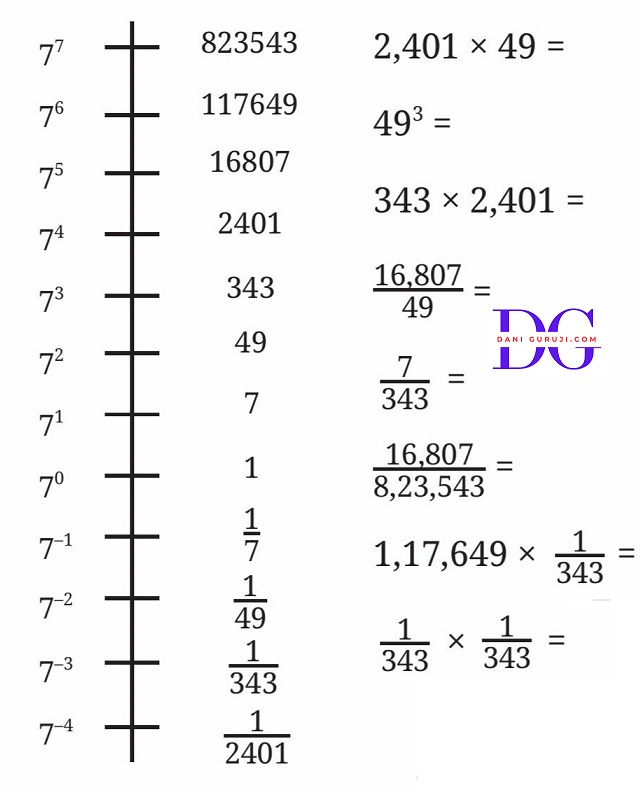
Use the power line for 7 to answer the following questions.


Solution :


1. Calculate the value of : $2,401 \times 49$


Convert the numbers to powers of 7:

$2,401 = 7^4$ and $49 = 7^2$


Use the Product Rule ($7^a \times 7^b = 7^{a+b}$):

$$ = 7^4 \times 7^2$$

$$ = 7^{4+2}= 7^6 $$


2. Calculate the value of : $49^3$


Convert the numbers to powers of 7:

$49 = 7^2$


Use the Power Rule ($(7^a)^b = 7^{a \times b}$):

$$ = (7^2)^3 $$

$$ = 7^{2 \times 3} = 7^6$$


3. Calculate the value of : $343 \times 2,401$


Convert the numbers to powers of 7:

$343 = 7^3$ and $2,401 = 7^4$


Use the Product Rule ($7^a \times 7^b = 7^{a+b}$):

$$ = 7^3 \times 7^4 $$

$$ = 7^{3+4} = 7^7$$


4. Calculate the value of : $\frac{16,807}{49}$


Convert the numbers to powers of 7:

$16,807 = 7^5$ and $49 = 7^2$


Use the Quotient Rule ($\frac{7^a}{7^b} = 7^{a-b}$):

$$ = \frac{7^5}{7^2} $$

$$ = 7^{5-2} = 7^3$$


5. Calculate the value of : $\frac{7}{343}$


Convert the numbers to powers of 7:

$7 = 7^1$ and $343 = 7^3$


Use the Quotient Rule ($\frac{7^a}{7^b} = 7^{a-b}$):

$$ = \frac{7^1}{7^3} $$

$$ = 7^{1-3} = 7^{-2}$$


6. Calculate the value of : $\frac{16,807}{8,23,543}$


Convert the numbers to powers of 7:

$16,807 = 7^5$ and $8,23,543 = 7^7$


Use the Quotient Rule ($\frac{7^a}{7^b} = 7^{a-b}$):

$$ = \frac{7^5}{7^7} $$

$$ = 7^{5-7} = 7^{-2}$$


7. Calculate the value of : $1,17,649 \times \frac{1}{343}$


Convert the numbers to powers of 7:

$1,17,649 = 7^6$ and $\frac{1}{343} = 7^{-3}$


Use the Product Rule ($7^a \times 7^b = 7^{a+b}$):

$$ = 7^6 \times 7^{-3} $$

$$ = 7^{6 + (-3)} = 7^3$$


8. Calculate the value of : $\frac{1}{343} \times \frac{1}{343}$


Convert the numbers to powers of 7:

$\frac{1}{343} = 7^{-3}$


Use the Product Rule ($7^a \times 7^b = 7^{a+b}$):

$$ = 7^{-3} \times 7^{-3} $$

$$ = 7^{(-3) + (-3)} = 7^{(-6)}$$


Question 3

We have used numbers like 10, 100, 1000, and so on when writing Indian numerals in an expanded form.
Write these numbers in the same way: (i) 172, (ii) 5642, (iii) 6374.


Solution :


Expanded Form Using Powers of 10


(i) 172


Convert the numbers in to the place value system:

$172 = (1 \times 100) + (7 \times 10) + (2 \times 1)$


Convert the numbers to powers of 10:

$$ \mathbf{(1 \times 10^2) + (7 \times 10^1) + (2 \times 10^0)}$$


(ii) 5,642


Convert the numbers in to the place value system:

$5,642 = (5 \times 1000) + (6 \times 100) $ $+ (4 \times 10) + (2 \times 1)$


Convert the numbers to powers of 10:


$ \mathbf{(5 \times 10^3) + (6 \times 10^2)} $ $ \mathbf{ + (4 \times 10^1) + (2 \times 10^0)}$


(iii) 6,374


Convert the numbers in to the place value system:

$6,374 = (6 \times 1000) + (3 \times 100) $ $+ (7 \times 10) + (4 \times 1)$


Convert the numbers to powers of 10:


$ \mathbf{(6 \times 10^3) + (3 \times 10^2) }$ $ \mathbf{+ (7 \times 10^1) + (4 \times 10^0)}$


Page 31 - 32 Scientific Notation
Question 1

Write the large-number facts we read just before in this form (scientific notation).
(i) The Sun is located 30,00,00,00,00,00,00,00,00,000 m from the centre of our Milky Way galaxy.
(ii) The number of stars in our galaxy is 1,00,00,00,00,000.
(iii) The mass of the Earth is 59,76,00,00,00,00,00,00,00,00,00,000 kg.


Solution :


Scientific Notation

Here are the large numbers written in scientific notation (a number between 1 and 10 multiplied by a power of 10):


(i) Sun's Distance from Milky Way Center


$$30,00,00,00,00,00,00,00,00,000 $$

$$ = \mathbf{3.0 \times 10^{20}} \text{ m}$$


(ii) Number of Stars in Our Galaxy


$$1,00,00,00,00,000 $$

$$= \mathbf{1.0 \times 10^{11}} \text{ stars}$$


(iii) Mass of the Earth


$$59,76,00,00,00,00,00,00,00,00,00,000 $$

$$ = \mathbf{5.976 \times 10^{24}} \text{ kg}$$


Question 2

The distance between the Sun and Saturn is 14,33,50,00,00,000 m =$ 1.4335 × 10^{12}$ m.
The distance between Saturn and Uranus is 14,39,00,00,00,000 m = $ 1.439 × 10^{12} $ m.
The distance between the Sun and Earth is 1,49,60,00,00,000 m = $ 1.496 × 10^{11} $ m.
Can you say which of the three distances is the smallest?


Solution :


Since $10^{11}$ is a smaller order of magnitude than $10^{12}$, the distance between the Sun and Earth is the smallest.


Question 3

Express the following numbers in standard form.
(i) 59,853
(ii) 65,950
(iii) 34,30,000
(iv) 70,04,00,00,000


Solution :


Standard Form

To convert these numbers, we move the decimal point until there is only one non-zero digit to its left and count the number of places moved to determine the power of 10.


(i) 59,853


The decimal point is moved 4 places to the left:

$$ = \mathbf{5.9853 \times 10^4}$$


((ii) 65,950


The decimal point is moved 4 places to the left:

$$ = \mathbf{6.595 \times 10^4}$$


(iii) 34,30,000


The decimal point is moved 6 places to the left:

$$ = \mathbf{3.43 \times 10^6}$$


(iv) 70,04,00,00,000


The decimal point is moved 10 places to the left:

$$ = \mathbf{7.004 \times 10^{10}}$$


Page 35 - 43 Scientific Notation
Question 1

How many times can a person circumnavigate (go around the world) the Earth in their lifetime if they walk non-stop? Consider the distance around the Earth as 40,000 km.


Solution :


Here, human Life Expectancy Used as a typical lifespan for calculation = 80 yrs.

Maximum walking hours per day = 8 hours


Earth's Circumference $40,000 \text{ km}$


Average Human Walking Speed $5 \text{ km/h}$

Per Day Walking Time $$ = \mathbf{8.0 \times 5 } \text{ km}$$

Per Day Walking km $$ = \mathbf{40 } \text{ km}$$


Calculate Total Walking Hours in a Lifetime


$$ = 80 \times 365 \times 40 $$

$$ = 11,68,000 \text{ km}$$


Calculate Total Laps


$$\text{Total Laps} = \frac{11,68,000 \text{ km}}{40,000 \text{ km}}$$

$$\text{Total Laps} \approx \mathbf{29.2 \text{ times}}$$


Question 2

With a global human population of about 8 × $10^9 $ and about 4 × $10^5$ African elephants, can we say that there are nearly 20,000 people for every African elephant?


Solution :


$$\text{Ratio} = \frac{\text{Human Population}}{\text{Elephant Population}}$$


$$\text{Ratio} = \frac{8 \times 10^9}{4 \times 10^5}$$


$$ = 2 \times 10^{9-5}$$

$$= 2 \times 10^4$$

Number of people per elephants

$$20,000$$


Question 3

Calculate and write the answer using scientific notation:
(i) How many ants are there for every human in the world?
(ii) If a flock of starlings contains 10,000 birds, how many flocks could there be in the world?
(iii) If each tree had about 104 leaves, find the total number of leaves on all the trees in the world.
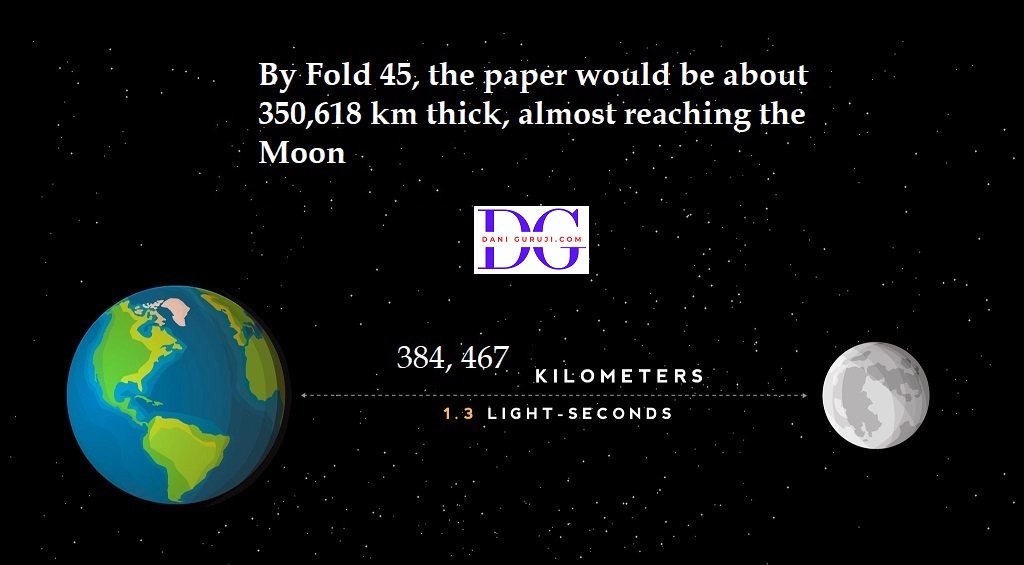
(iv) If you stacked sheets of paper on top of each other, how many would you need to reach the Moon?


Solution :


Calculations in Scientific Notation


(i) Ants per Human


We use the approximate global ant population ($10^{16}$) and the human population ($8 \times 10^9$).


$$\text{Ants / Human} = \frac{\text{Ant Population}}{\text{Human Population}}$$

$$ = \frac{1 \times 10^{16}}{8 \times 10^9}$$

$$0.125 \times 10^{16-9} $$

$$ 0.125 \times 10^7 $$

$$= \mathbf{1.25 \times 10^6}$$

(ii) Number of Starling Flocks


We use the estimated global starling population ($\approx 1.5 \times 10^9$ birds) and the size of one flock ($10,000 = 1 \times 10^4$ birds)..


$$\text{Number of Flocks} = \frac{\text{Total Starlings}}{\text{Birds per Flock}}$$

$$ = \frac{1.5 \times 10^9}{1 \times 10^4}$$

$$= \mathbf{1.5 \times 10^{9-4}}$$

$$= \mathbf{1.5 \times 10^5}$$

There could be approximately $\mathbf{1.5 \times 10^5}$ (150,000) flocks of that size in the world.


(iii) Total Number of Leaves on All Trees


We multiply the estimated number of trees ($3 \times 10^{12}$) by the leaves per tree ($10^4$).


$\text{Total Leaves}$ $= (\text{Total Trees}) \times (\text{Leaves per Tree})$

$$ = (3 \times 10^{12}) \times (1 \times 10^4)$$

$$ \mathbf{3 \times 10^{12+4}} $$

$$\mathbf{3 \times 10^{16}}$$

here are approximately $\mathbf{3 \times 10^{16}}$ total leaves on all the trees in the world.


(iv) Sheets of Paper to Reach the Moon


We divide the distance to the Moon ($\approx 3.844 \times 10^8 \text{ meters}$) by the thickness of one sheet of paper ($\approx 0.1 \text{ mm} = 1 \times 10^{-4} \text{ meters}$).


$\text{Sheets Needed} = \frac{\text{Distance to Moon}} {\text{Thickness of one Sheet}} $

$$ = \frac{3.844 \times 10^8}{1 \times 10^{-4}}$$

$$\mathbf{3.844 \times 10^{8 - (-4)} }$$

$$\mathbf{3.844 \times 10^{12}}$$

You would need approximately $\mathbf{3.844 \times 10^{12}}$ (3.84 trillion) sheets of paper to reach the Moon.


Question 4

If you have lived for a million seconds, how old would you be?


Solution :


1. Seconds Count for a Day


First, we calculate the total number of seconds in one day:


$\text{Seconds in a Day}$ $= 24 \frac{\text{hours}}{\text{day}} \times 60 \frac{\text{minutes}}{\text{hour}} \times 60 \frac{\text{seconds}}{\text{minute}} $

$$ = \mathbf{86,400 \text{ seconds}}$$


2. Calculating the Ager (The Ratio)


To find your age in days, you must divide the total seconds you lived by the seconds in one day:


$$\text{Age (Days)} = \frac{1,000,000}{86,400}$$

$$\text{Age (Days)} \approx \mathbf{11.574 \text{ days}}$$

If you lived for a million seconds, you would be 11 days and about 14 hours old.


Question 5

A fossil of Kelenken Guillermoi, a type of terror bird, is dated to 15 million years ago ( ≈_______________ seconds).


Solution :


1. Seconds Count for a Day


First, we calculate the total number of seconds in one day:


$\text{Seconds in a Day}$ $= 24 \frac{\text{hours}}{\text{day}} \times 60 \frac{\text{minutes}}{\text{hour}} \times 60 \frac{\text{seconds}}{\text{minute}} $

$$ = \mathbf{86,400 \text{ seconds}}$$


$$\text{Seconds in a Year } = 365 \times 86,400 $$

$$\text{Seconds in a Year } = \mathbf{31,536,000 \text{ sec.}}$$


Fossil Age ($15$ Million Years)


$\text{Total Seconds} $ $= 15,000,000 \text{ yrs.} \times 31,536,000 $


$\text{Total Sec.} = 473,040,000,000,000 \text{ sec.}$


$$\mathbf{4.7304 \times 10^{14} \text{ seconds}}$$


Page 44 - 45 Figure it Out
Question 1

Find out the units digit in the value of $2^{224}$ ÷ $4^{32}$ ?


Solution :


Simplify the Expression

The goal is to get a single power of 2. We can rewrite $4$ as $2^2$:


$$2^{224} \div 4^{32}$$

$$ = 2^{224} \div (2^2)^{32}$$

$$ = 2^{224} \div 2^{(2 \times 32)}$$

$$2^{224} \div 2^{64} $$


Now, Use the Quotient Rule (subtract the exponents):

$$ = 2^{(224 - 64)} $$

$$ = 2^{160}$$

Find the Units Digit


The units digits of powers of 2 follow a pattern that repeats every 4 exponents (a cycle of 4):


$2^1$ = 2 (units digit 2)

$2^2$ = 4 (units digit 4)

$2^3$ = 8 (units digit 8)

$2^4$ = 16 (units digit 6)

$2^5$ = 32 (units digit 2)

$2^6$ = 64 (units digit 4)

$2^7$ = 108 (units digit 8)

$2^8$ = 216 (units digit 6)


The pattern of units digits is 2, 4, 8, 6, and it repeats every 4 powers.


To find the units digit of $2^{160}$, we check the remainder when the exponent $160$ is divided by the cycle length $4$.

Since the remainder is $0$, the units digit of $2^{160}$ is the last digit in the cycle, which is 6.


Question 2

There are 5 bottles in a container. Every day, a new container is brought in. How many bottles would be there after 40 days?


Solution :


Simplify the Expression


Number of containers added every day = 1

Since a new container is brought in every day for 40 days, the total number of containers brought in is 40.

Number of containers after 40 days = 40 containers


Since every container holds 5 bottles,

$$\text{Total Bottles} = 40 \text{ containers} \times 5 $$

$$\text{Total Bottles} = \mathbf{200 \text{ bottles}}$$


After 40 days the total number of bottles would be 200.


Question 3

Write the given number as the product of two or more powers in three different ways. The powers can be any integers.

(i) $64^3$
(ii) $192^8$
(iii) $32^{-5}$


Solution :


Here we applying the Product Rule of Exponents ($n^a \times n^b = n^{a+b}$) in reverse.


(i) $64^3$

The base $64$ can be written as $2^6$ or $4^3$ or $8^2$.


Way 1: Splitting the Exponent

$$64^3 = 64^{(2 + 1)} $$

$$64^3 = \mathbf{64^2 \times 64^1}$$


Way 2: Using Base 8

$$64^3 = (8^2)^3 $$

$$ = 8^{2 \times 3} = 8^6$$

Now, split the exponent $6 = 4 + 2$:

$$8^6 = \mathbf{8^4 \times 8^2}$$


Way 3: Using Base 2

$$64^3 = (2^6)^3 $$

$$= 2^{6 \times 3} = 2^{18}$$

Now, split the exponent $18 = 10 + 3 + 5$:

$$2^{18} = \mathbf{2^{10} \times 2^{3} \times 2^{5}}$$


(ii) $192^8$

First, find the prime factorization of $192$:
$192^8 = (2^6 \times 3^1)^8$


Way 1: Splitting the Exponent

$$192^8 = 192^{(3 + 5)} $$

$$192^8 = \mathbf{192^3 \times 192^5}$$


Way 2: Distributing the Exponent

$$ 192^8 = (2^6 \times 3^1)^8$$

$$ = \mathbf{(2^6)^8 \times (3^1)^8} $$

$$ = \mathbf{2^{48} \times 3^8} $$


Way 3: By changing the base of the first term

$$ = \mathbf{(2^6)^8 \times (3^1)^8} $$

$$ = \mathbf{2^{48} \times 3^8} $$

$$ = \mathbf{(2^3)^{16} \times (3^1)^8} $$

Now,

$$ = \mathbf{(8)^{16} \times (3^1)^8} $$


(iii) $32^{-5}$

The base $32$ can be written as $2^5$.


Way 1: Splitting the Exponent

$$32^{-5} = 32^{(-3) + (-2)} $$

$$= \mathbf{32^{-3} \times 32^{-2}}$$


Way 2: Using Base 2

$$32^{-5} = (2^5)^{-5}$$

$$ = 2^{5 \times (-5)} = 2^{-25}$$

Now, split the exponent $-25 = -20 + (-5)$:

$$ = \mathbf{2^{-20} \times 2^{-5}}$$


Way 3: Using Both Positive and Negative Integers

$$32^{-5} = 32^{(0) + (-5)} $$

$$ = \mathbf{32^0 \times 32^{-5}}$$


Question 4

Examine each statement below and find out if it is ‘Always True’, ‘Only Sometimes True’, or ‘Never True’. Explain your reasoning.

(i) Cube numbers are also square numbers.
(ii) Fourth powers are also square numbers.
(iii) The fifth power of a number is divisible by the cube of that number.
(iv) The product of two cube numbers is a cube number.
(v) q46 is both a 4th power and a 6th power (q is a prime number).


Solution :


1. Cube numbers are also square numbers.


Only Sometimes True


A number is both a cube and a square if its prime factors have exponents that are multiples of both 2 and 3 (i.e., multiples of 6).


True Example:: Number $64$ is a cube ($4^3 = 64$) and a square ($8^2 = 64$). This is because $64 = 2^6$, and 6 is divisible by both 2 and 3.


False Example:: Number $8$ is a cube ($2^3 = 8$) but not a square


2. Fourth powers are also square numbers.


Always True


A fourth power of any number $n$ can be written as $n^4$.
Any number raised to the power of 4 can also be expressed as a square because $4$ is divisible by $2$

Since $n^4$ is the square of the integer $n^2$, it is always a square number.


Example: $3^4 = 81$. Since $81 = 9^2$, it is a square number.


3. The fifth power of a number is divisible by the cube of that number.


Always True (Provided the base number is a non-zero integer)


Let the number be $n$. The statement asks if $n^5$ is divisible by $n^3$.

If $\frac{n^5}{n^3} = n^{5-3} = n^2$.


Since the result ($n^2$) is an integer (or a whole number if $n$ is an integer), $n^5$ is always perfectly divisible by $n^3$.


Example: $5^5$ (3125) divided by $5^3$ (125) equals $5^2 = 25$.


4. The product of two cube numbers is a cube number.


Always True


Let the two cube numbers be $a^3$ and $b^3$.

$$ a^3 \times b^3 = (a \times b)^3$$

Since the result is the cube of the number $(a \times b)$, it is always a cube number.


Example: $2^3 \times 3^3 = 8 \times 27 = 216$. Since $216 = 6^3$, it is a cube number.


5. $q^{46}$ is both a 4th power and a 6th power ( $q$ is a prime number)


Never True


Reasoning: For $q^{46}$ to be:.

A 4th power, the exponent ($46$) must be divisible by $4$.

A 6th power, the exponent ($46$) must be divisible by $6$.


We check the divisibility:


$46 \div 4 = 11$ with a remainder of $2$. (Not divisible by 4)

$46 \div 6 = 7$ with a remainder of $4$. (Not divisible by 6)


Since $46$ is not divisible by either $4$ or $6$, $q^{46}$ cannot be expressed as $(q^a)^4$ or $(q^b)^6$.


Question 5

Simplify and write these in the exponential form.

(i) $10^{-2} \times 10^{-5}$
(ii) $5^7 \div 5^4$
(iii) $9^{-7} \div 9^4$
(iv) $(13^{-2})^{-3}$
(v) ${m^5 n^{12}} \times {(mn)^9}$


Solution :


(i) $10^{-2} \times 10^{-5}$


Use the Product Rule ($n^a \times n^b = n^{a+b}$):


$$10^{-2} \times 10^{-5} = 10^{(-2) + (-5)} $$

$$ = \mathbf{10^{-7}}$$


(ii) $5^7 \div 5^4$


Use the Quotient Rule ($n^a \div n^b = n^{a-b}$):


$$5^7 \div 5^4 = 5^{(7 - 4)}$$

$$ = \mathbf{5^3}$$


(iii) $9^{-7} \div 9^4$


Use the Quotient Rule ($n^a \div n^b = n^{a-b}$):


$$9^{-7} \div 9^4 = 9^{(-7) - 4} $$

$$ = \mathbf{9^{-11}}$$


(iv) $(13^{-2})^{-3}$


Use the Power Rule ($(n^a)^b = n^{a \times b}$):


$$(13^{-2})^{-3} = 13^{(-2) \times (-3)} $$

$$ = \mathbf{13^6}$$


(v) ${m^5 n^{12}} \times {(mn)^9}$


Use the Product Rule ($n^a \times n^b = n^{a+b}$):


${m^5 n^{12}} \times {(mn)^9} $

$= {m^5 n^{12}} \times {m^9 n^9}$

$ = m^{5 + 9} \times n^{12 + 9} $

$ = m^{14} \times n^{21} $


Question 6

If $12^2$ = 144 what is

(i) $(1.2)^2$
(ii) $(0.12)^2$
(iii) $(0.012)^2$
(iv) $120^2$


Solution :


(i) $(1.2)^2$


When squaring a number with one decimal place, the result will have two decimal places.


$$(1.2)^2 = \mathbf{1.44}$$


(ii) $(0.12)^2$


When squaring a number with two decimal places, the result will have four decimal places ($2 \times 2 = 4$).


$$(0.12)^2 = \mathbf{0.0144}$$


(iii) $(0.012)^2$


When squaring a number with three decimal places, the result will have six decimal places ($3 \times 2 = 6$).


$$(0.012)^2 = \mathbf{0.000144}$$


((iv) $120^2$


$120^2$ is $(12 \times 10)^2$. We square both terms:


$$120^2 = 12^2 \times 10^2 $$

$$= 144 \times 100 = \mathbf{14,400}$$


Question 7

Circle the numbers that are the same —

(i) $2^4 \times 3^6$
(ii) $6^4 \times 3^2$
(iii) $6^{10}$
(iv) $18^2 \times 6^2$
(v) $6^{24}$


Solution :


We will express all numbers in terms of their prime factors, $2$ and $3$, since $6 = 2 \times 3$.


(i) $2^4 \times 3^6$


(ii) $6^4 \times 3^2$


$(2 \times 3)^4 \times 3^2 $

$= 2^4 \times 3^4 \times 3^2$

= $\mathbf{2^4 \times 3^6}$


(iii) $6^{10}$


$(2 \times 3)^{10}$

= $\mathbf{2^{10} \times 3^{10}}$


(iv) $18^2 \times 6^2$


$(2 × 3 × 3)^2 \times (2 × 3)^2$

$ {2^2 × 3^2 × 3^2} \times {2^2 × 3^2}$

= $\mathbf{2^4 \times 3^6}$


(v) $6^{24}$


$(2 × 3)^{24} $

= $ {2^{24} × 3^{24} }$


The expressions that simplify to the same value are: $\mathbf{2^4 \times 3^6}$, and $6^4 \times 3^2$ , and $18^2 \times 6^2$


Question 8

Identify the greater number in each of the following —

(i) $4^3$ or $3^4$
(ii) $2^8$ or $8^2$
(iii) $100^2$ or $2^{100}$


Solution :


To identify the greater number, we need to calculate or simplify each expression.


(i) $4^3$ or $3^4$


$4^3 = 4 \times 4 \times 4 = \mathbf{64}$


$3^4 = 3 \times 3 \times 3 \times 3 $

$ = 9 \times 9 = \mathbf{81}$


Conclusion: $\mathbf{3^4}$ is greater.


(ii) $2^8$ or $8^2$


$2^8 = 2 \times 2 \times 2 \times 2 \times 2 \times 2 \times 2 \times 2 $

$ = 16 \times 16 = \mathbf{256}$


$8^2 = 8 \times 8 = \mathbf{64}$


Conclusion: $\mathbf{2^8}$ is greater.


(iii) $100^2$ or $2^{100}$


$100^2 = 100 \times 100 = \mathbf{10,000}$


$2^{100}$ can be written as

$(2^{10})^{10} = (1,024)^{10}$.


Since $1,024 > 100$, raising $1,024$ to the power of $10$ will result in a number vastly larger than $10,000$.


Conclusion: $\mathbf{2^{100}}$ is greater.


Question 9

A dairy plans to produce 8.5 billion packets of milk in a year. They want a unique ID (identifier) code for each packet. If they choose to use the digits 0–9, how many digits should the code consist of?


Solution :


Define the Total Required Codes


The dairy needs a unique code for every packet produced in the year.


$\text{Req. Unique Codes}

$ = 8.5 \text{ billion} = 8,500,000,000$

In scientific notation, this is $\mathbf{8.5 \times 10^9}$.


The code can use the digits 0 through 9

$$\text{Number of Characters (Base)} = 10$$


The Smallest Number of Digits


We need to find the smallest integer $n$ (number of digits) such that the total combinations ($10^n$) are greater than or equal to the required codes ($\mathbf{8.5 \times 10^9}$).


$$∴ 10^n \ge 8.5 \times 10^9$$


We check powers of 10 around the required number of codes:


9 digits: $10^9 = 1,000,000,000$ (1 billion)

Not satisfied the condition ($1 \text{ billion} < 8.5 \text{ billion}$. Insufficient.)


10 digits: $10^{10} = 10,000,000,000$ (10 billion)

Yes, $10 \text{ billion} \ge 8.5 \text{ billion}$. Sufficient.


The code should consist of 10 digits to ensure a unique ID for every packet.


Question 10

64 is a square number ($ 8^2 $) and a cube number ($ 4^3 $). Are there other numbers that are both squares and cubes? Is there a way to describe such numbers in general?


Solution :


Yes, there are infinitely many numbers that are both square numbers and cube numbers.


These numbers can be generally described as perfect sixth powers.


Perfect sixth powers


A number that is both a perfect square ($n^2$) and a perfect cube ($m^3$) is called a perfect sixth power.

This means we can find any such number by taking an integer (k) and raising it to the power of 6.


Examples of Square and Cube Numbers


Base No. (k) = 1, Number ($k^6$)= 1, As a Square ($(\mathbf{k^3})^2$)= $1^2$, As a Cube ($(\mathbf{k^2})^3$)= $1^3$


Base No. (k) = 2, Number ($k^6$)= 64, As a Square ($(\mathbf{k^3})^2$)= $8^2$, As a Cube ($(\mathbf{k^2})^3$)= $4^3$


Base No. (k) = 3, Number ($k^6$)= 729, As a Square ($(\mathbf{k^3})^2$)= $27^2$, As a Cube ($(\mathbf{k^2})^3$)= $9^3$


Base No. (k) = 4, Number ($k^6$)= 4,096, As a Square ($(\mathbf{k^3})^2$)= $64^2$, As a Cube ($(\mathbf{k^2})^3$)= $16^3$


Question 11

A digital locker has an alphanumeric (it can have both digits and letters) passcode of length 5. Some example codes are G89P0, 38098, BRJKW, and 003AZ. How many such codes are possible?


Solution :


To solve it, we need to determine the total number of possible characters and the length of the passcode.


Determine the Character Set


The passcode is alphanumeric, meaning it includes both digits (0-9) and letters (A-Z).

Digits: There are 10 possible digits (0-9).

Letters: There are 26 possible letters (A-Z).

Total options for a single position: 10 + 26 = 36 characters


The passcode has a fixed length of 5 positions.


Since each of the 5 positions can be filled by any of the 36 characters, we multiply the number of options for each position together.


This is calculated as 36 raised to the power of 5 = $ 36^5$

$$36^5 = 60,466,176$$


There are 60,466,176 possible alphanumeric codes of length 5.


Question 12

The worldwide population of sheep (2024) is about $10^9$ , and that of goats is also about the same. What is the total population of sheep and goats?

(i) $20^9$ (ii) $10^{11}$
(iii) $10^{10}$ , (iv) $10^{18}$
(v) $2 \times 10^9$, (vi) $10^9 + 10^9$


Solution :


Total Population: Population of Sheep + Population of Goats


$$\text{Total Population} = 10^9 + 10^9$$


$$= 2 \times 10^9 $$


The correct answers are :

(v) $2 \times 10^9$ , This is the simplified result of the addition.

And (vi) $10^9 + 10^9$ This is the direct expression of the sum .


Question 13

Calculate and write the answer in scientific notation:

(i) If each person in the world had 30 pieces of clothing, find the total number of pieces of clothing.
(ii) There are about 100 million bee colonies in the world. Find the number of honeybees if each colony has about 50,000 bees.
(iii) The human body has about 38 trillion bacterial cells. Find the bacterial population residing in all humans in the world.
(iv) Total time spent eating in a lifetime in seconds.


Solution :


(i) Total Number of Pieces of Clothing


To solve this , we'll use the approximate current world human population (2024), which is about $8 \text{ billion} = 8 \times 10^9$.


Total Number of Pieces of Clothing


$\text{Total Clothing} = (\text{World Population})$ $ \times (\text{Clothing per Person})$

$$ = (8 \times 10^9) \times 30$$

$$= (8 \times 10^9) \times (3 \times 10^1)$$

( Add exponents: $10^9 \times 10^1 = 10^{9+1} = 10^{10}$ )

$$ = 24 \times 10^{10}$$

Convert to standard scientific notation

$$ = 2.4 \times 10^{11}$$


There are approximately $\mathbf{2.4 \times 10^{11}}$ pieces of clothing globally.


(ii) Total Number of Honeybees


We multiply the number of bee colonies by the average number of bees per colony.


$\text{Total Bees} = $ $(\text{Total Colonies}) \times (\text{Bees per Colony})$

$$\text{Total Bees} = (1 \times 10^8) \times (5 \times 10^4)$$

$$\text{Result} = \mathbf{5 \times 10^{12}}$$


The total number of honeybees is approximately $\mathbf{5 \times 10^{12}}$.


(iii) Total Bacterial Population in All Humans


We multiply the world human population by the bacterial cells per person ($38$ trillion).


$\text{Total Bacteria} = $ $(\text{World Population})$ $ \times (\text{Bacterial Cells per Human})$

$$ = (8 \times 10^9) \times (3.8 \times 10^{13})$$

$$ = 30.4 \times 10^{22}$$


Convert to standard scientific notation:

$$30.4 \times 10^{22} = (3.04 \times 10^1) \times 10^{22} $$

$$ = \mathbf{3.04 \times 10^{23}}$$


The total bacterial population residing in all humans is approximately $\mathbf{3.04 \times 10^{23}}$ cells.


(iv) Total Time Spent Eating in a Lifetime in Seconds


Average Lifetime: $80 \text{ years}$

Time Spent Eating per Day: $1 \text{ hour}$ (This is an estimate, assuming 20 minutes for each of 3 meals).


We multiply the average lifetime by the simplified days per year.

$$\text{Total Days} $$

$$ = 80 \text{ years} \times 365 \frac{\text{days}}{\text{year}} $$

$$ = \mathbf{29,200 \text{ days}}$$


Total Hours Spent Eating : as 1 hour of eating per day,

$ = \mathbf{29,200 \text{ hours}}$


Total Seconds Spent Eating


There are 3,600 seconds in one hour ($60 \times 60 = 3,600$).


$\text{Total Sec.} = 29,200 \text{ hrs.} \times 3,600 \frac{\text{sec.}}{\text{hour}} $


$= \mathbf{105,120,000 \text{ seconds}}$

$ = \mathbf{1.0512 \times 10^8 \text{ seconds}}$


Question 14

What was the date 1 arab/1 billion seconds ago?


Solution :


Let Start Date: Sunday, December 14, 2025 at 12:00:00 AM UTC


Time to Subtract: $1,000,000,000 \text{ seconds}$


Time in Days: $1,000,000,000 \text{ seconds} \div 86,400 \frac{\text{seconds}}{\text{day}} $


Time in Days: $ \approx 11,574.074 \text{ days}$


Date 1 Billion Seconds Ago (IST) Thursday, April 07, 1994 at 03:43:20 AM IST


Syllabus for class 10

Advanced courses and exam preparation.

Previous Year Paper

Advanced courses and exam preparation.

Mock Test

Explore programming, data science, and AI.